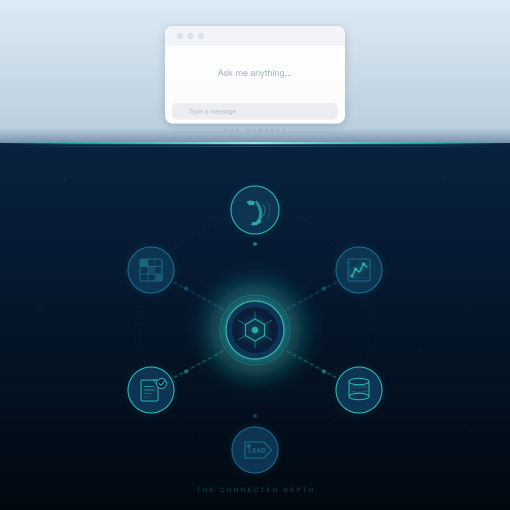
Most people meet AI through a chat box. That’s a bit like meeting the internet through a single website. Useful, but it hides almost everything that’s actually going on. For businesses, the shift worth paying attention to is happening one layer down — and the value isn’t in the tools. It’s in what you connect to them.
When the web first arrived, the thing that hooked people was content. You could sit at a desk in Auckland and look at the Vatican. You could read a newspaper from London while your coffee was still hot. For a while, that’s what “the internet” meant. Websites you went to visit.
We know now that wasn’t really what the web was. Websites were the first obvious use of it. Underneath, the web was a way for any two computers to talk to each other, and that turned into banking, video calls, supply chains, GPS in your pocket, the lights in your house. The browsing-the-Vatican phase was the surface.
I think AI is in the same spot right now. For most people, AI is ChatGPT. You type a question and you get an answer back. That’s the chatbot experience, and it’s genuinely useful. It’s something like instant access to knowledge, the way the early web gave you instant access to content. But it’s the surface.
The other way in
The chat box is one way to use a model. The API is the other one, and it’s where most of the interesting work is happening. In plain terms, the API is a programmatic interface into the same knowledge that’s inside the chatbot. Your existing systems can ask the questions and use the answers. The whole thing runs in the background.
Two things become possible. You can automate work that used to need a person. And you can augment work you already do with a layer of intelligence that didn’t exist before. Either you get knowledge you’ve never had, or you finally get to use the knowledge you’ve had sitting in recordings, spreadsheets, and inboxes.
Two examples make this concrete.
Example one: call tracking
Call tracking has been around for years. On a Google Ads campaign, when someone clicks an ad and lands on the site, the phone number swaps out for a tracked number. When they ring, we can tie that call back to the ad, often back to the exact keyword they searched. For a long time that was the cutting edge of phone-call attribution. A business owner could see they got 14 calls from Google last week, and which campaigns drove them.
Useful. Also the surface.
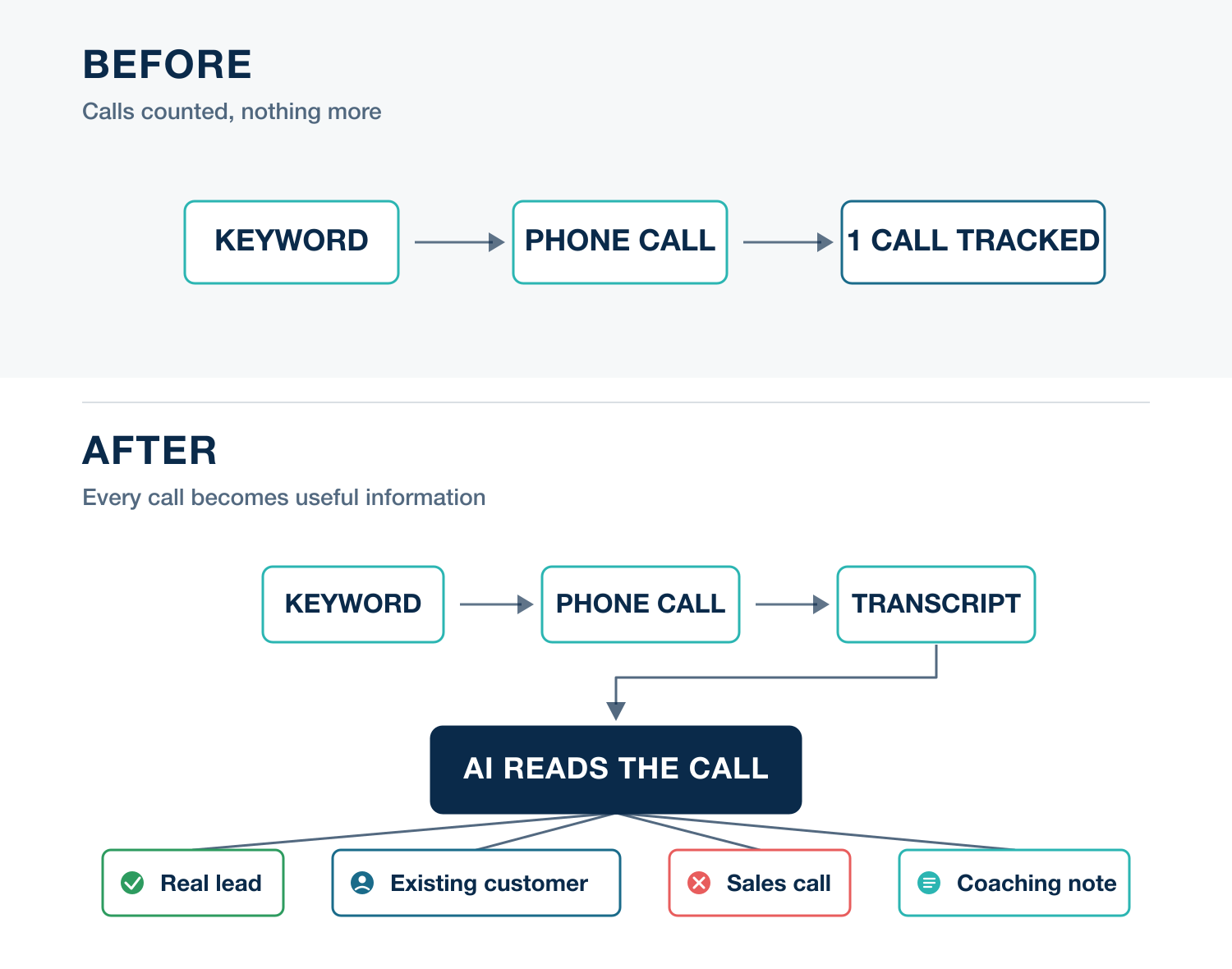
What’s available now is everything that happens inside the call. The recording gets transcribed automatically. A model reads the transcript and can tell when a call is a real lead versus an upset customer versus a supplier pitching for business. It writes a short summary of what the call was about, whether it was a genuine lead, how the team handled it, and where there were openings the call-taker missed.
A few things shift when that happens.
“Calls” stops being a single number. Calls split into actual leads, existing-customer calls, and people trying to sell to the business. The business owner has always known their team was fielding sales calls, but the agency couldn’t see them, so every call counted the same. Reality and the report finally line up.
The call-handling itself becomes coachable. Instead of a manager sitting in on calls one at a time, you have a written summary of every conversation with notes on what worked. People who answer phones for a living have something to work with that they’ve never had before.
And the client and the agency are looking at the same thing. There’s no more “we drove you 40 calls” / “yeah but half of them were rubbish.” The system can see which were rubbish, and why, and that conversation gets a lot more honest.
“It really is gold. It helps give you the full circle picture of what is happening with your leads.”
— Sasha, Drain Ninjas
None of that is the chatbot. Nobody is sitting at ChatGPT pasting in transcripts. The model is plugged into the recording system, the recording system is plugged into the reporting, and the whole thing runs on its own.
Example two: weekly reporting
The same pattern shows up in reporting. A business running ads across Google, Meta, maybe Bing, plus organic Google traffic and a website, is sitting on data in five or six different places. Pulling it together for a management meeting used to mean a person in spreadsheets for half a day.
That work doesn’t need to happen anymore. The data can be pulled automatically every week, summarised, compared against previous periods, and delivered as a report with the insight already extracted. Not just the numbers, but what changed and what’s worth doing about it. You walk into the Monday meeting already informed.
“The reporting from Ark gives me a real understanding of how the business is performing. I’m not having to dig for it.”
— Carey, Milly’s Kitchen
Where the value actually lives
Both of those examples are useful on their own. A call summary is better than no summary, and a weekly report is better than no report. But the value flattens out quickly if that’s all you’ve got. Generic insight becomes wallpaper.
Two extra layers are what turn this from useful into genuinely valuable.
Memory
The system needs to remember what’s happened across activities, so it can spot patterns rather than describe single events. Over a month, that means you can see when calls about a particular product keep coming in tricky and the team consistently mishandles them. The conversation worth having there is about training, not call volume. You can also see when one person on the team is unusually good at converting first-time enquiries. The question then becomes how that person trains the rest. Single events are noise. Patterns are signal.
Context
The system also needs to know what matters to your business specifically. That might be the products carrying the most margin, so calls about those get more attention. It could be a newsletter going out next Tuesday, with the report needing to capture whether it lifted enquiries. Or it’s that your busy season starts in October, so a dip in September isn’t a problem. None of that lives in the data. It comes from you. And when you feed it in, the AI work coming back out gets noticeably sharper.
This is the part that most people don’t see when they’re judging AI from the chatbot experience. The chatbot doesn’t know you. It can’t. That’s not what it’s for.
The Venn
The way we think about it at Ark is a Venn diagram.
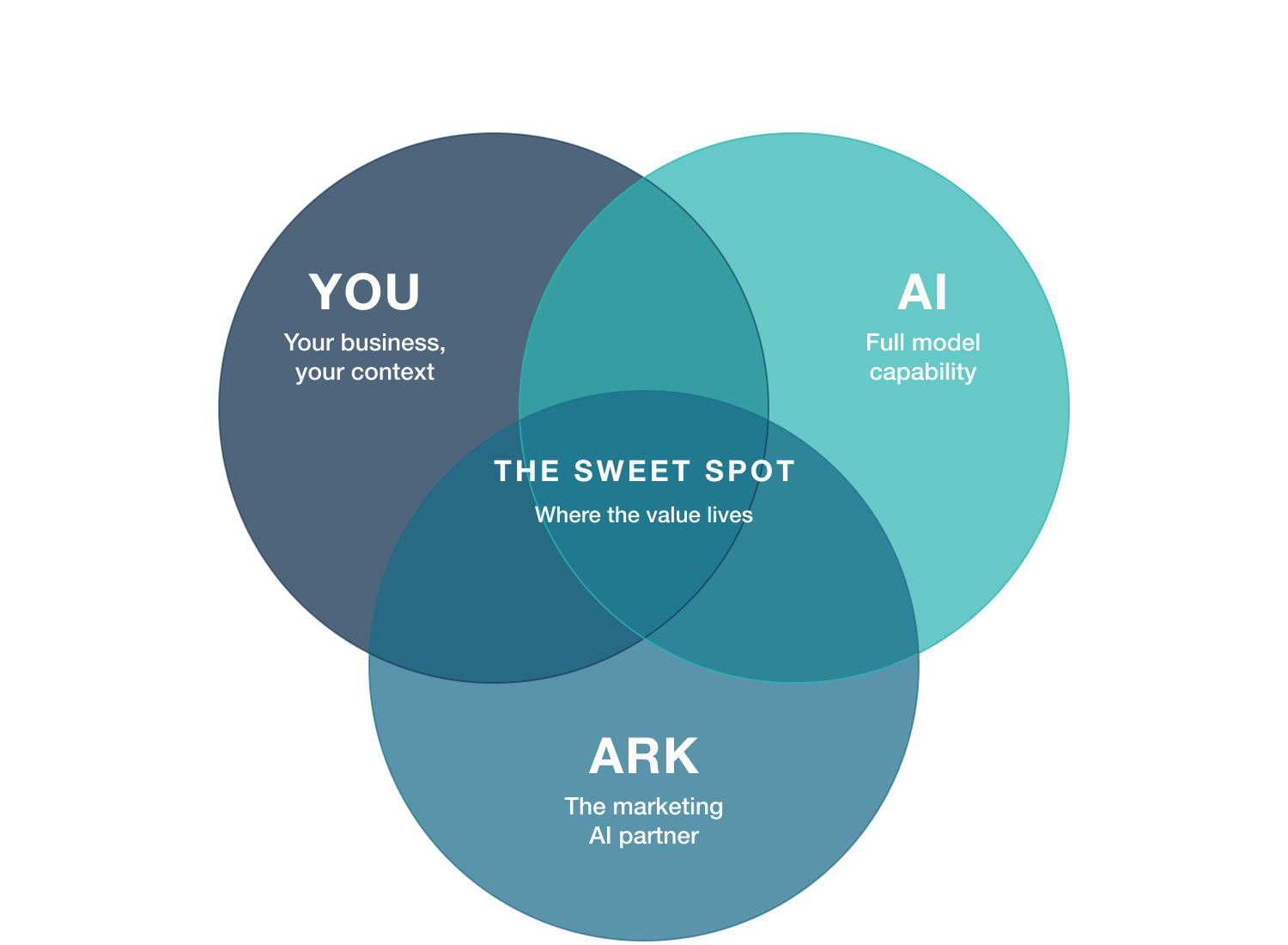
The chatbot lives entirely in the AI circle on its own. Anything you get out of it is generic, because it’s working without your context and without memory of your business. Get the three circles overlapping properly and you get something else. The same AI capability, but pointed at your business, with memory and context layered in. That’s where the beautiful music gets made.
What we’re looking for
The Marketing AI Partner role is what Ark is building toward. Most of our work now sits in that middle circle, connecting AI capability to the customer’s context and memory in ways that produce reporting, insight, and operational support a business can actually act on.
If you’re a business owner who’s looked at AI so far as a chat tool and quietly wondered whether there’s more to it, there is. We’d like to show you what it looks like for your business specifically. Use the form below and we’ll set up a conversation about what the next step could be.