
The productivity gain from AI is real, and it is arriving faster than most people planned for. What almost nobody is deciding on purpose is what to do with it. You can use it to do the same work with fewer people, or the same people to do far more. One of those feels safe. In a market with competitors, it might be the riskier choice.
In the last few weeks two things landed that pointed in opposite directions.
In May the New Zealand government told us how it plans to use AI. The plan is to shrink. A sinking lid on agency budgets, mergers, digitisation, and the public service falling from around 65,000 people to about 55,000 by 2029. Roughly ten thousand fewer roles, for a saving of $2.4 billion over four years. The framing is that the money gets redeployed to the frontline, which sounds positive, but the lever being pulled is simple. Fewer people doing the same work.
Then this month, Anthropic, one of the companies actually building this technology, published a piece on what they call recursive self-improvement. The short version is that AI is now building AI. More than 80% of their production code is written by their own model. They measure engineers shipping eight times more code than two years ago. The work the most expensive technical people on earth used to do by hand is increasingly being done by the thing they built. And it is speeding up.
So you have one organisation using AI to get smaller, and another using it to grow as fast as it possibly can. Same technology. Two completely different decisions about what to do with it.
I think that decision is the part worth paying attention to, and I think most businesses are about to make it by accident.
The dividend nobody is naming
Whatever your business does, some part of it is information work. Writing, quoting, reporting, answering, scheduling, analysing. AI is making that part cheaper and faster, and that is not a prediction any more, it is just happening. Call it a productivity dividend. You are going to get one. The size depends on how much of your work is the kind a machine can help with, but the direction is the same for almost everyone.
The question is what you spend it on. There are really only two answers.
Option A is to bank it. Do the same work with fewer people, or the same people in less time, and keep the saving. This is the reflex. It is what the government chose. It feels responsible, it shows up cleanly on a spreadsheet, and it is the first thing most of us think of.
Option B is to spend it. Keep your people, and use the freed-up capacity to do much more. Serve customers better, build the thing you never had time for, go after work that was not economic before. This is closer to what Anthropic is doing. It is messier and harder to put a number on.
A feels safe. B feels like a gamble. I have started to think it is the other way around.

Why the safe option might be the dangerous one
Here is the thing about the AI dividend that makes it different from most business advantages. It is not yours. Your competitor is buying the same tools, in the same week, off the same shelf. The moment an advantage is available to everyone, it stops being an advantage and becomes the new baseline.
That is what makes Option A weaker than it looks. If you bank the gain as cost, you have not lowered your costs compared to your competitors. You have lowered them to a floor that everyone else is dropping to as well. You did a bunch of work to stand still.
And cost-cutting is symmetric. Anything you find, your competitor finds too, because they have the same tools. So it is a race to the same place, with thinner margins for everyone and a real advantage for nobody.
Innovation is not symmetric. A genuinely better offer is hard to copy. If your competitor spends their dividend building something new while you spend yours trimming the existing thing, you are not slightly behind them. You are defending a position they are about to make irrelevant. You do not lose to the competitor who is 10% cheaper. You lose to the one who changed what the customer expects.
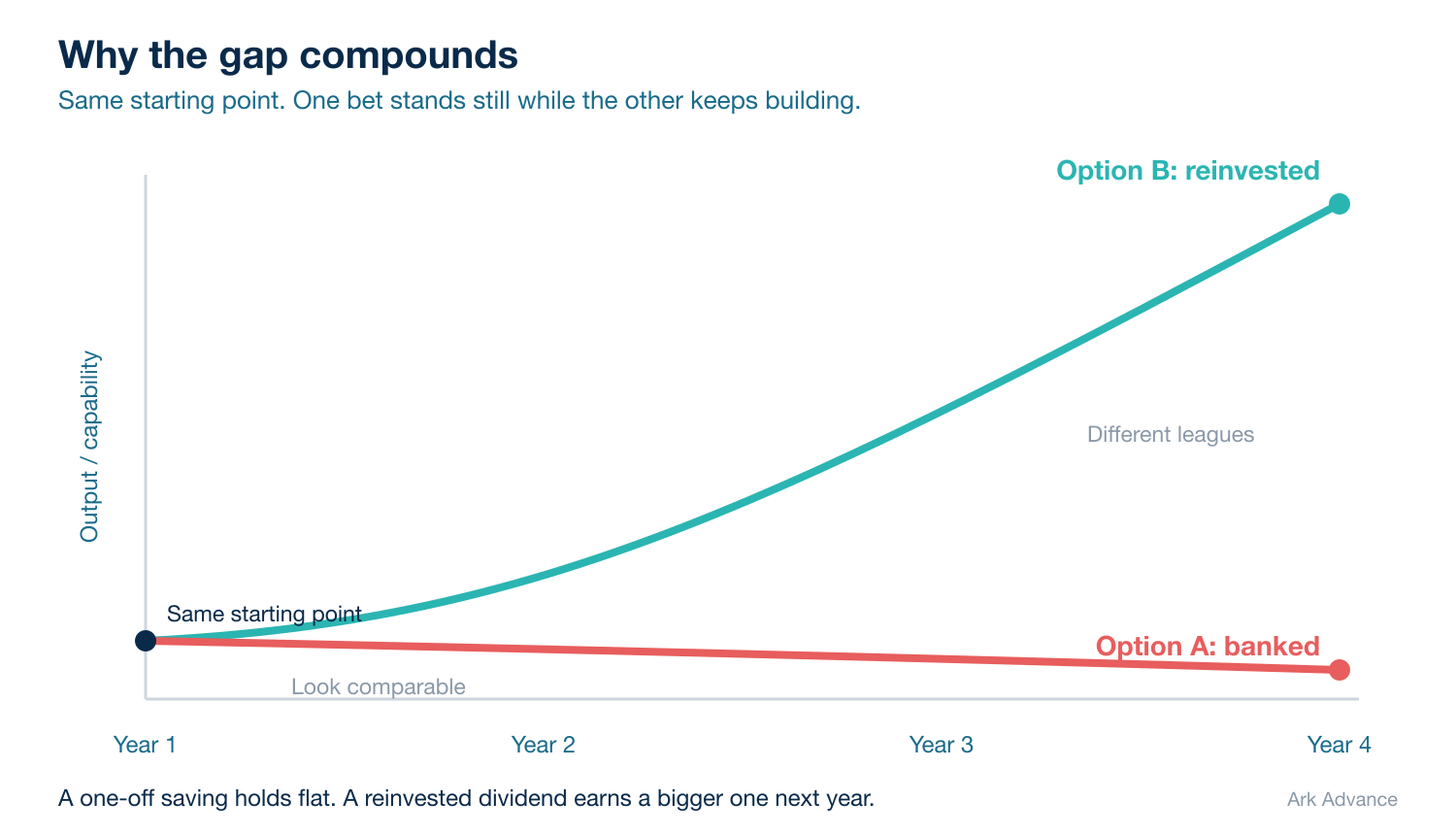
Because the technology is still accelerating, this gap widens rather than holding steady. The business that reinvests this year’s dividend builds capability that earns a bigger dividend next year. The business that banks it gets a one-off saving and then stands still while the other one compounds. A year in they look comparable. A few years in they are not in the same conversation.
So why can the government get away with it?
This is the part that I think makes the comparison fair rather than just a cheap shot.
The government can take Option A safely. It has no competitor. Nobody is going to launch a rival public service that does immigration and tax better and steal its customers. When you cannot be replaced, banking the saving is a perfectly rational move, and redeploying it to the frontline is a good outcome.
You almost certainly do not have that luxury. You have competitors, and that changes the maths completely. The same choice that is sensible for a monopoly is exposed for a business in a contested market. So the lesson is not that the government is wrong. It is that the government can afford a choice you cannot.
I would not push this too far. Some markets run on trust and relationships, and those move slower. I have written before that the work done face to face has more runway than the work done file to file, and I still think that is true. But runway is not immunity. Your relationship advantage holds right up until a competitor uses their dividend to match your service and undercut your price at the same time. The more your market is contested and commoditised, the less time you have.
The honest version
I want to be careful not to turn this into a sermon, because the simple version is too tidy and real businesses are not.
Banking some of the gain is fine. Cost discipline is not a sin. The trap is making A the destination rather than the first step. A as a full stop is the problem. A as a comma, where you free up money and then point it at something, is just sensible.
And B is not a licence to bet the farm. The reason I think B is the lower-risk move is that you are deciding what to do with a dividend, not gambling your core capital. Reinvesting found money into capability is a very different act from staking the savings account on a hunch. At the scale most of us operate, B is rarely a moonshot anyway. It is usually just doing the obvious thing you have always been too stretched to do.
I could be wrong about how big this dividend gets. For a business that is mostly hands-on work, it might be modest. For one that is mostly information, it might be enormous. I do not think I am wrong about the choice it forces, though, and the choice is the same at any size. Of whatever gain you get, are you banking it or spending it?
The decision is being made in every business right now, whether the owner is making it on purpose or letting the spreadsheet make it for them. It is worth making it on purpose.
If you want a hand working out which of the two your business is set up for, that is the kind of conversation we enjoy having.