Originally published January 2025. Fully rewritten March 2026 to reflect 18 months of real-world data.
Google’s AI Overviews have been live in New Zealand for over a year now. The early panic about traffic collapse wasn’t wrong — but it wasn’t the full picture either. Here’s what the data actually shows after 18 months, and what it means for your business.
The landscape has shifted — fast
When I first wrote this post in early 2025, AI Overviews had just landed in New Zealand as part of Google’s global rollout. We had early data and a lot of speculation. Now we have real numbers — and they tell a more nuanced story than either the optimists or the doomsayers predicted.
Here’s what’s changed:
- AI Overviews now appear in up to 55% of Google searches (Ahrefs, 25 million AIOs analysed) — more than doubling since March 2025
- Google launched AI Mode in March 2025, a dedicated AI search tab powered by Gemini 2.0 — it now has 75 million daily active users globally
- AI Overviews serve 2 billion monthly users across 200+ countries and 40+ languages
- Google expanded AI Overview advertising to New Zealand in December 2025 — ads now appear alongside AIOs in roughly 40% of cases, up from just 3% at the start of 2025
The feature isn’t experimental anymore. It’s the new default for how a large chunk of search works.
The numbers that matter
The impact on organic traffic is real, and the data has only gotten clearer.
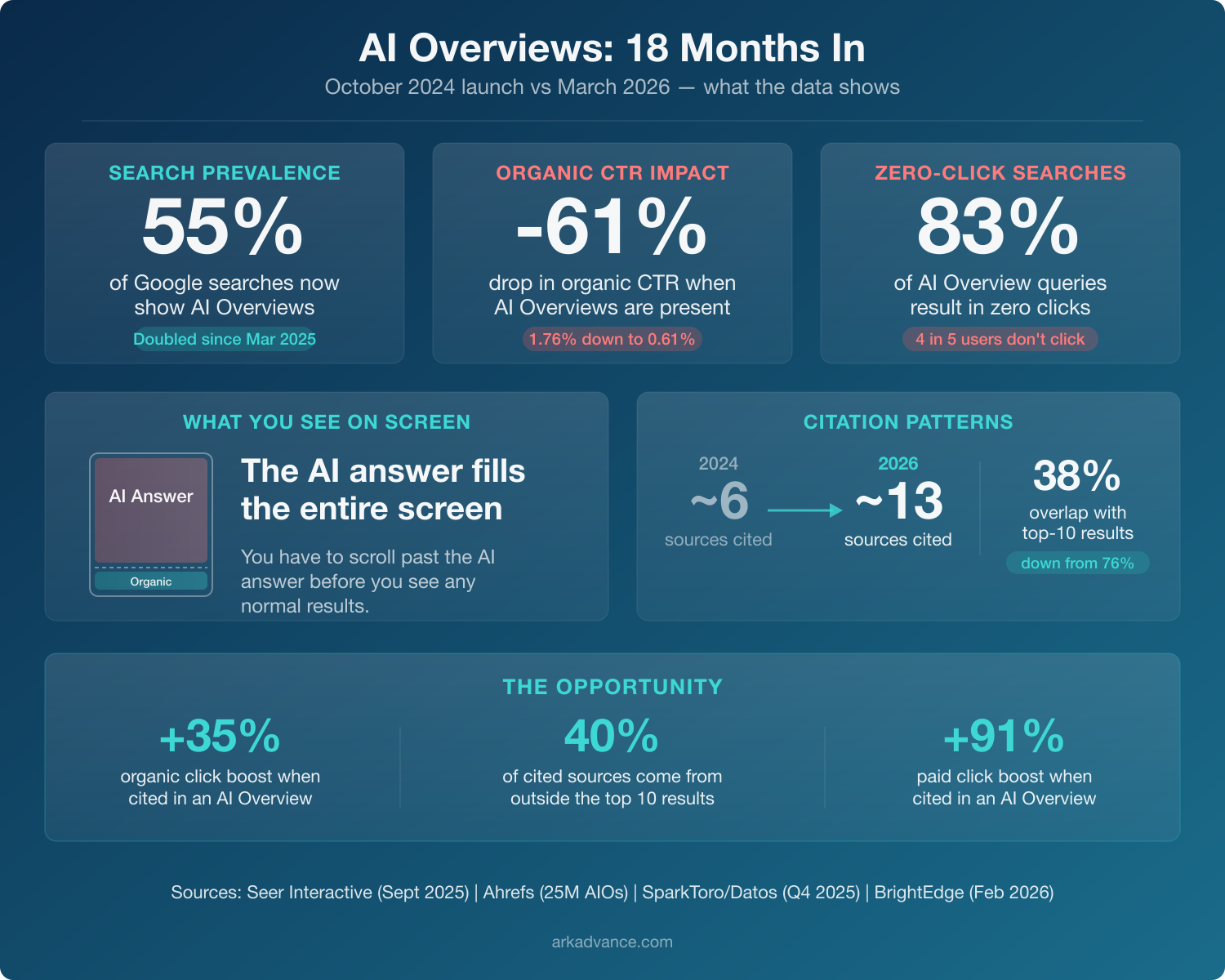
Click-through rates have dropped hard. A Seer Interactive study tracking 3,119 queries across 42 organisations found organic CTR fell from 1.76% to 0.61% — a 61% decline — when AI Overviews are present. Even queries without AI Overviews saw CTR drop 41%. Nobody’s immune.
Most people don’t click at all. SparkToro’s Q4 2025 research shows 58% of all Google searches now result in zero clicks. For queries where AI Overviews appear specifically, that jumps to 83%. Four out of five users get what they need without visiting a single website.
The AI answer takes up more than a full screen. When an AI Overview appears, it’s so tall that it fills your entire screen — and then some. You have to scroll down past the AI-generated answer before you see the first normal search result. On a phone, it’s even worse. The traditional “page one of Google” that businesses have been fighting over for years? It’s now page two in practice.
Publishers are feeling it. Global publisher traffic from Google dropped by a third in 2025. Some major sites lost 40-55% of their Google traffic year-on-year.
But there’s a flip side
Before you write off organic search entirely, some of the data points in a more interesting direction.
Being cited in an AI Overview actually helps. The same Seer Interactive study found that pages cited in an AI Overview got a 35% boost in organic clicks and a 91% boost in paid clicks compared to pages that weren’t cited. If Google’s AI recommends you, people are more likely to click through and trust you.
Google is pulling from deeper than page one. Citation overlap with the top-10 organic results has dropped from 76% to just 38% (Ahrefs). That means 40% of AI Overview sources come from pages ranked 11th or lower. You don’t need to be on page one to get cited — you need to be genuinely useful.
More sources are getting a look-in. AI Overviews now cite an average of 13 sources per response, up from about 6 in 2024. The door is wider than it was.
What this means for Kiwi businesses
If you’re running a business in New Zealand, here’s the practical takeaway:
Local and transactional queries are your stronghold. AI Overviews appear most often for broad informational queries — the “what is…” and “how does…” type searches. Local searches (“plumber near me,” “Auckland accountant”) and transactional queries (“buy,” “book,” “get a quote”) are far less affected. This is where most small and medium businesses make their money anyway.
Your content needs to be structured for citation. 78% of AI Overviews contain lists — ordered or unordered. If your content uses clear headings, bullet points, and concise 30-50 word answer blocks, you’re more likely to be pulled into an AI Overview as a source. Think about how you’d answer a customer’s question in a quick, direct paragraph — that’s what Google’s AI is looking for.
Authority matters more than ever. Google’s AI is highly selective. Out of millions of indexed domains, only a tiny fraction get cited. The sites that do tend to have strong E-E-A-T signals — real expertise, genuine experience, proper author credentials, and a track record of quality content. For service businesses, that means showcasing your actual work, real results, and genuine knowledge.
YouTube and community content are rising fast. YouTube is now the most-cited domain in AI Overviews, and Reddit’s citation share grew 450% in the first half of 2025. If you’re creating video content or participating authentically in community discussions, you’re building the kind of signals Google’s AI values.
What to do about it
Here are the practical steps we’re recommending to our clients right now:
- Audit your content for “citability.” Look at your key service pages and blog posts. Are they structured with clear headings and concise, direct answers? Would Google’s AI be able to pull a clean, useful snippet from your content?
- Don’t abandon SEO — refocus it. Organic search isn’t dead, but the strategy needs adjusting. Focus on transactional and local intent keywords where AI Overviews are less prevalent. Make sure your Google Business Profile is optimised — local results still sit above AI Overviews in many cases.
- Review your paid strategy. With paid CTR also declining (from 19.7% to 6.3% for AIO queries), your Google Ads approach may need recalibrating. Shopping ads still appear above AI Overviews 80% of the time — if you’re in e-commerce, that’s worth leaning into.
- Build genuine authority. Create content that demonstrates real expertise and first-hand experience. Detailed case studies, original research, expert commentary — these are the signals that get you cited, not keyword-stuffed blog posts.
- Track your AI visibility. Check whether your content appears in AI Overviews for your key search terms. This isn’t something you can automate easily yet, but regular manual spot-checks in incognito mode will show you where you stand.
The bigger picture
Eighteen months ago, I wrote this post as a heads-up about something new. Now AI Overviews aren’t new — they’re normal. Google is processing over a billion AI queries a month and showing no signs of pulling back.
The businesses that will do well in this environment are the ones that focus on being genuinely useful, properly structured, and clearly authoritative. That’s always been good SEO advice — it just matters more now.
If you’d like to understand what AI Overviews mean for your SEO, get in touch and we’ll walk you through it.