Originally published July 2011. Fully rewritten March 2026 to reflect how Facebook and Instagram advertising works today.
I still don’t love Facebook. I barely post, I never scroll, and I’m fairly sure the algorithm has given up on me. But after managing Meta advertising campaigns for businesses across New Zealand for over a decade, I can tell you this: whether you enjoy the platform is completely irrelevant to whether it can grow your business.
The biggest shift since 2011
When I first wrote about Facebook back in 2011, the advice was all about building a following. Get people to “Like” your page, post regularly, build engagement, and your audience would see your content.
That world is gone.
Organic reach — the percentage of your followers who actually see your posts — has been declining for years. For most business pages it sits in the low single digits. Post something to your 2,000 followers and maybe 40 people will see it.
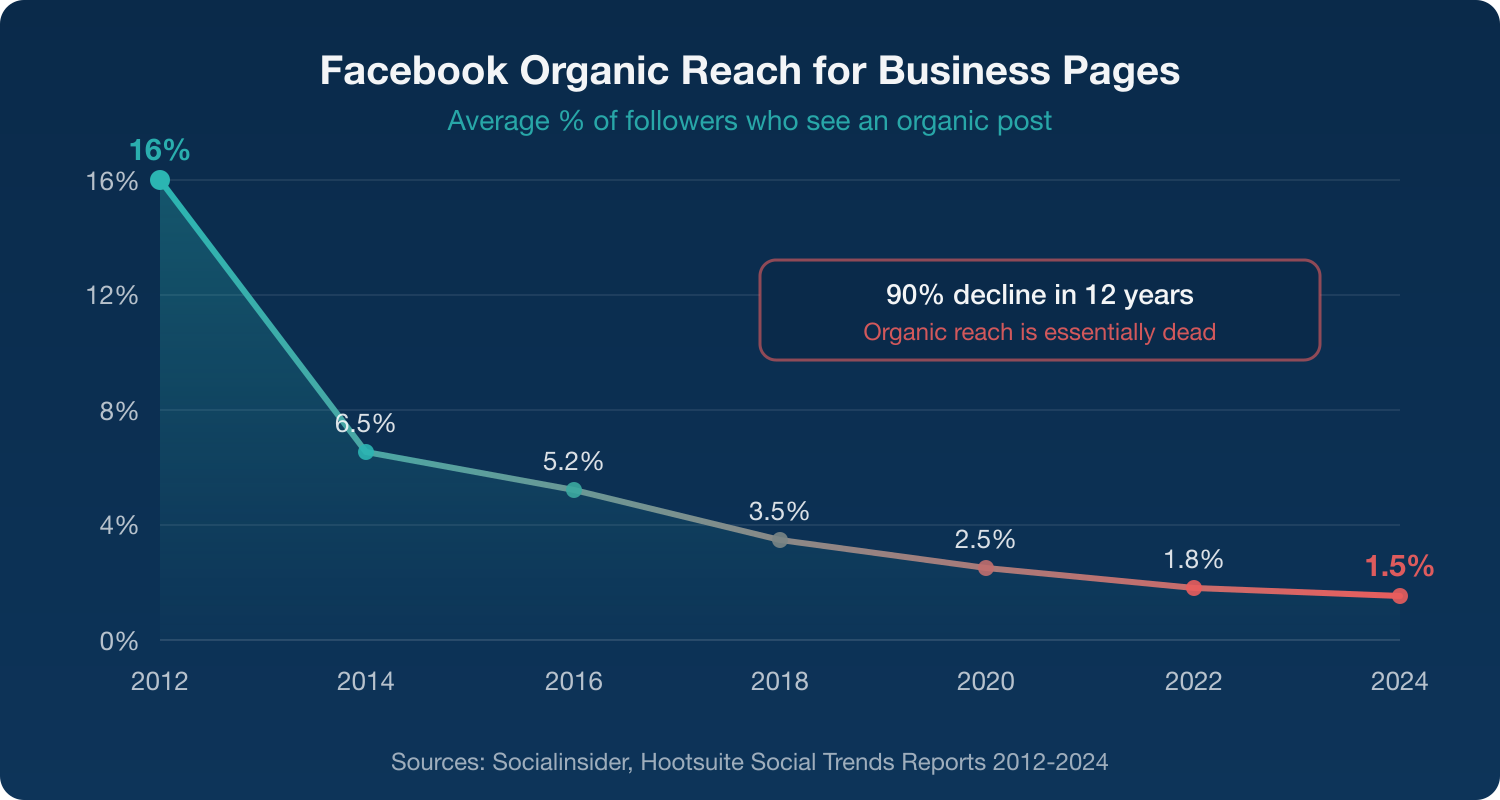
This frustrates business owners who spent years building a following. But here’s the thing: it doesn’t matter. Because the advertising side of Meta has become extraordinarily good at putting your message in front of exactly the right people — whether they follow you or not.
You don’t need a big following. You don’t even need to post regularly. What you need is a clear message, decent creative, and someone who knows how to run the campaigns.
Why Meta advertising still works (despite everything)
There’s a reason Meta reported over $160 billion in ad revenue in 2024. The targeting works.
Not because you pick a list of interests and hope for the best — that’s how it used to work. These days, Meta’s AI does most of the heavy lifting. You tell it what a conversion looks like (a form submission, a phone call, a purchase), feed it some creative, and its algorithm finds the people most likely to take that action.
This is a genuine shift from even a few years ago. The old approach was to build tightly defined audiences — women aged 35-54 in Auckland who like renovation magazines. That still has its place, but increasingly the best results come from giving Meta’s Advantage+ system a broader audience and letting the algorithm optimise.
It sounds counterintuitive. Trust the robot with your money? But the data backs it up. Meta’s machine learning has access to signals across Facebook, Instagram, Messenger, and the wider web that no human media buyer could process manually.
What makes a good Meta ad in 2026
The flip side of algorithm-driven targeting is that creative matters more than ever. When the algorithm handles who sees your ad, the variable you control is what they see.
A few things we’ve learned managing campaigns for New Zealand businesses:
Video outperforms static images — even short, simple video. A 15-second clip of a real person talking about what they do will almost always beat a stock photo with text overlay. It doesn’t need to be polished. In fact, overly produced content often performs worse because it looks like an ad and people scroll past.
Lead with the outcome, not the feature. “See what your kitchen could look like” beats “Custom kitchen design services.” People on Facebook aren’t searching for you — you’re interrupting their scroll. Give them a reason to stop.
The first three seconds decide everything. If you haven’t caught attention by then, you’ve lost them. Open with movement, a bold statement, or something visually striking.
Where Meta fits in your marketing
Facebook and Instagram advertising works differently from Google Ads, and understanding the difference is important.
On Google, people are actively searching. They type “kitchen renovations Auckland” because they’re already in buying mode. Your job is to be there when they look.
On Meta, nobody is looking for you. They’re watching their friend’s holiday photos or scrolling Reels. Your job is to interrupt that scroll with something compelling enough to plant a seed — or nurture one that’s already been planted.
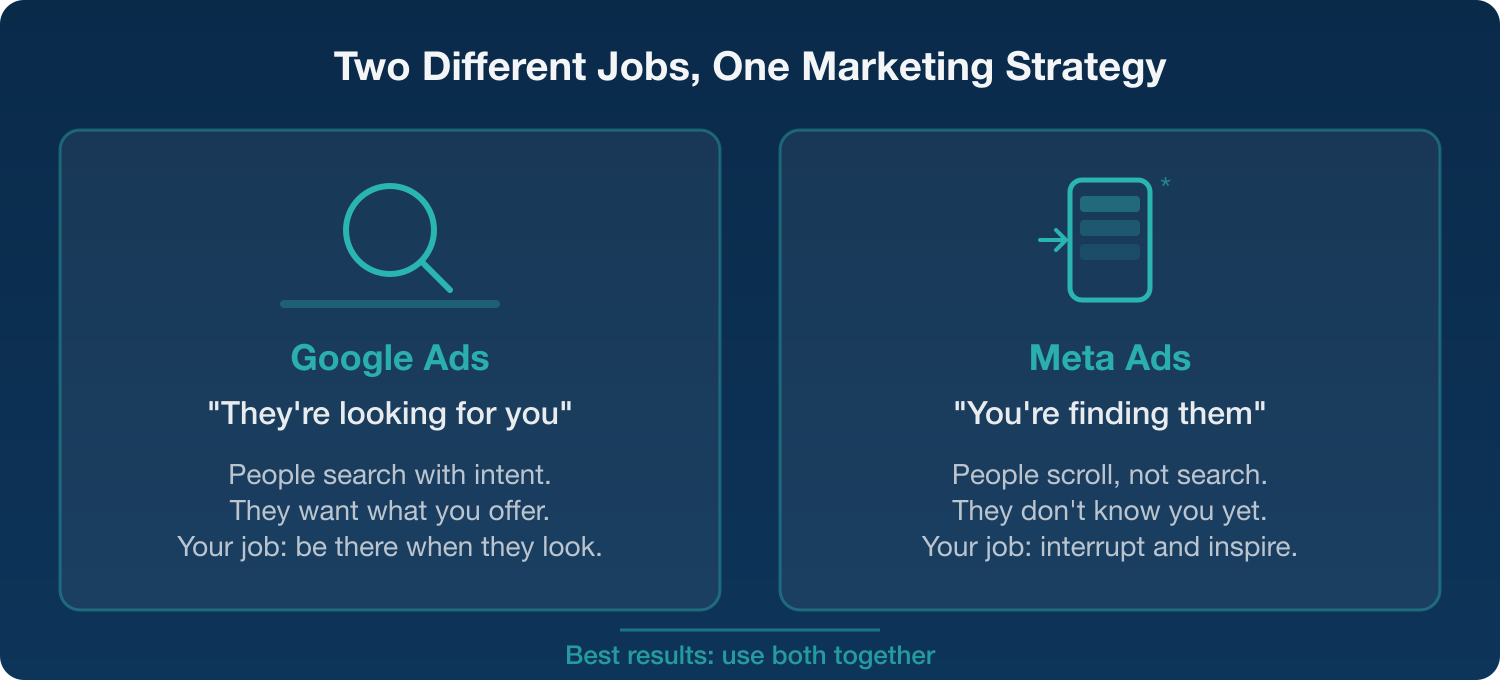
This makes Meta particularly effective for two things:
Building awareness early in the buying cycle. Someone planning a home renovation might not search Google for months. But they’re on Instagram every day. Showing them beautiful examples of your work now means that when they do eventually search, your name is already familiar. That familiarity is worth real money — branded search terms on Google are dramatically cheaper than generic ones.
Retargeting people who’ve already shown interest. Someone visited your website but didn’t enquire? Meta lets you show them a follow-up ad on Facebook or Instagram within hours. This is one of the highest-ROI tactics in digital marketing because you’re reaching people who’ve already raised their hand.
The strongest campaigns we run combine both: broad awareness campaigns to introduce the brand, followed by retargeting to bring warm prospects back.
The “I tried it and it didn’t work” conversation
I have this conversation regularly. A business owner tried boosting a few posts, spent a few hundred dollars, got some likes but no leads, and concluded that Facebook advertising doesn’t work for their industry.
Here’s what usually went wrong:

They boosted posts instead of running proper campaigns through Ads Manager. Boosting is Meta’s gateway drug — it’s easy to do but gives you almost none of the targeting, tracking, or optimisation tools that make the platform effective.
They had no conversion tracking set up, so they had no way of knowing whether the advertising actually generated leads. Traffic arrived on their website and disappeared into a black hole.
They ran the campaign for two weeks and expected results. Meta’s algorithm needs time to learn — typically two to four weeks of data before it starts optimising effectively.
None of these are reasons Facebook advertising doesn’t work. They’re reasons a particular approach didn’t work.
Getting started (properly)
If you’re considering Facebook or Instagram advertising, the entry point is lower than most people think. You don’t need a massive budget, you don’t need professional video production, and you definitely don’t need to enjoy using the platform.
What you do need is a clear understanding of who you’re trying to reach, a message that resonates with them, and someone who can set up and manage the campaigns properly — including the tracking that tells you whether it’s actually working.
That last part is where most DIY attempts fall down, and it’s where having an experienced team managing your Facebook and Instagram advertising makes the difference. Facebook and Instagram work best as part of a broader social media advertising strategy that accounts for where your customers actually are.
I may never become a Facebook enthusiast. But I’m a firm believer in what Meta advertising can do for the right business, run the right way.