I wasn’t looking for advertising insights. I was reading a book about the brain.
Dr. Jill Bolte Taylor’s Whole Brain Living landed on my reading list because I was curious about her journey after listening to her story on a podcast I follow. Jill is the Harvard-trained neuroanatomist who famously had a stroke and wrote about watching her own brain shut down in My Stroke of Insight.
In Whole Brain Living, she describes how our brains contain four distinct “characters”—two thinking modules and two emotional modules, split across our left and right hemispheres. What struck me wasn’t the self-help angle. It was this: our emotional brain processes information faster than our thinking brain can even register what’s happening.
I put the book down and thought about Google Ads.
Suddenly, all those feature-heavy ads I’d been reviewing made sense—not as effective advertising, but as a fundamental misunderstanding of how brains actually work.
The Realisation That Changed Everything
Here’s what I’d been seeing across dozens of client accounts:
- “Professional building services in Auckland”
- “Quality website design, competitive rates”
- “Experienced team, free quotes available”
Perfectly logical. Completely forgettable.
These ads were speaking directly to the rational, analytical brain—Character 1, in Jill’s framework. The problem? By the time Character 1 shows up to evaluate your ad, Character 2 (the emotional brain) has already decided whether to pay attention.
I started digging into the neuroscience research, using Claude to help me pull together relevant studies and build a framework I could actually apply. What emerged was a way to navigate the curious mix of emotional and rational advertising content.
What Actually Happens When Someone Sees Your Ad
Let me walk you through the timeline, because the speed of this is genuinely quite cool.
Your brain processes images in 13 milliseconds. MIT neuroscientists found that the human brain can identify entire images in as little as 13 milliseconds—far faster than the 100 milliseconds researchers previously assumed.
Text takes 100-300 milliseconds to process. Recognising a familiar word takes 100-200 milliseconds. Reading at normal speed runs about 300 milliseconds per word.
Emotional processing happens in 20-300 milliseconds. The amygdala—that ancient emotional alarm system—can trigger unconscious reactions in approximately 20 milliseconds. Conscious, cortical processing takes around 200 milliseconds.
So here’s the order your search ad actually gets processed:
- 0-13ms: Brain processes your image extension (if you have one)
- 20-130ms: Amygdala scans headline for emotional relevance
- 200-400ms: Conscious rational processing begins
- Decision made: Click or scroll past
Your competitor’s ad saying “Professional Building Services – Competitive Rates” never triggered the emotional system. It never captured attention in the first place.

Why Image Extensions Aren’t Optional
When I realised images are processed 8-23 times faster than text, I started paying closer attention to which search ads did and didn’t have image extensions showing. Now it’s interesting to note that Google will determine whether they’ll show them or not, so the fact you have them doesn’t guarantee they’re going to be shown. But what I didn’t know is how fast my brain was processing them.
Here’s the thing: while Google doesn’t guarantee they’ll show your image extensions, you must guarantee they’re ready to go:
- Available (uploaded and approved)
- Emotionally relevant (showing outcomes, not just products)
- High quality (clear, professional, attention-grabbing)
What I see too often:
- Stock photos of handshakes or generic office workers
- Product shots with no context or emotion
- Unclear or busy images
Your image is processed before they read a single word. Make it count.
The Insight That Really Changed Things: Loss Aversion
Reading about the emotional brain led me down a rabbit hole. Is the strength of every emotion the same? Are some emotions stronger when it comes to decision-making than others? I landed on Daniel Kahneman and Amos Tversky’s Nobel Prize-winning research on Prospect Theory.
Here’s the counterintuitive finding that most advertisers miss:
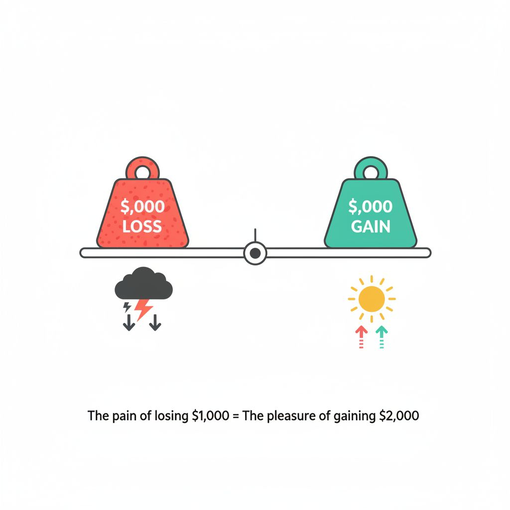
Negative emotions are 2-2.5 times more powerful than positive ones.
The research shows that the pain of losing $1,000 requires the pleasure of earning $2,000 to compensate. We take bigger risks to avoid losses than to achieve equivalent gains. And this isn’t cultural—a 2020 global study confirmed loss aversion across 19 countries and 13 languages.
Why? Evolutionary biology. Our ancestors who paid attention to threats survived. Those who focused on opportunities at the expense of dangers didn’t.
Look at the news if you want proof. Research across 17 countries found a universal negativity bias in how humans react to news stories. A massive study of viral content from Upworthy found that headlines with negative words received more clicks.
Why is news so negative? Because it captures our attention better. The same principle applies to your Google Ads.
Most businesses focus on positive emotions—excitement, happiness, achievement. But they’re fighting against our neurological wiring.
The 60/40 Rule To Consider
Based on the research, here’s the structure I’ve landed on for those precious 240 characters:
60% Emotion (with a bias toward loss aversion) 40% Logic (proof, features, guarantees)
This isn’t a number I invented. Analysis from the Institute of Practitioners in Advertising across 1,400 case studies found that purely emotional campaigns achieved 31% profitability increase compared to 16% for rational campaigns—nearly 2:1 performance.
The Emotional 60%
Loss Aversion (Most Powerful):
- “Stop losing customers to competitors with faster websites”
- “Don’t risk your team’s safety with substandard scaffolding”
- “Missing sales while competitors rank #1 on Google?”
- “Weather destroying your outdoor living space?”
Gain Framing (Needs to be 2x bigger to compete):
- “Double your leads” (not just “get more leads”)
- “Slash project delays by 50%”
- “Rank above ALL competitors in your area”
The gain needs to be significant enough to overcome our natural bias toward loss aversion. “Get more customers” doesn’t cut it. “Triple your customer base” might.
The Logical 40%
Once emotion has captured attention, logic seals the deal:
- “NZ Safety Standards Certified”
- “500+ Projects Completed”
- “Free Quote in 24 Hours”
- “15-Year Warranty”
- “Zero Incidents in 5 Years”
These remove objections and justify the emotional decision.
How It All Works Together
When someone searches “scaffolding Auckland,” here’s what their brain is actually doing:
0-13ms: Processes your image extension. Brain sees workers safely at height → instant visual of positive outcome.
20-130ms: Amygdala scans for emotional relevance. “Don’t Risk Worker Safety” → THREAT DETECTED → Attention captured. Loss aversion triggered (2x more powerful than gain).
200-400ms: Conscious processing begins. “NZ Safety Certified · Zero Incidents” → LOGIC validates emotional response. Rational brain provides justification for the emotional impulse.
Decision made: Click the ad. Emotion created desire. Logic removed barriers. Action feels justified and safe.
Your competitor’s ad: “Professional Scaffolding Services – Competitive Rates.” Generic image, pure logic, no emotional trigger. Never captured attention. Gets scrolled past.
Putting This Into Practice
Understanding the neuroscience is one thing. Applying it to your specific business is another.
The scaffolding example above works because it connects a genuine risk (worker safety) to a specific audience searching with intent. But what’s the equivalent emotional trigger for your business? What loss is your ideal customer trying to avoid? And is your current messaging tapping into that—or just listing features?
These are exactly the questions we dig into during our free 60-minute Marketing Message Audit. We’ll review your current messaging, identify where it’s speaking to logic when it should be triggering emotion, and give you specific, actionable recommendations you can implement straight away.
After 20+ years reviewing marketing messages, we’ve seen what works and what gets scrolled past. If you’re investing in Google Ads (or about to), this is where to start.