Originally published July 2012. Fully rewritten March 2026 to reflect how Google Ads works today.
When a multi-location business sets up separate Google Ads accounts for each branch, they almost always end up spending more and getting less. Here’s why one well-managed account will outperform a handful of fragmented ones — and why the fix is simpler than most people expect.
Every now and then, a business with multiple locations comes to us with the same story. Each branch has been running its own Google Ads account. Each branch manager picked their own keywords, wrote their own ads, and set their own budgets. On paper it sounds logical — local people managing local advertising.
In practice, it’s usually a mess.
The branches are bidding against each other, driving up their own costs, and none of them have enough data individually to optimise properly. Meanwhile, their competitors — running a single, well-structured account — are getting better results for less money.
Here’s why consolidation works.
You stop bidding against yourself
This is the big one — and it’s especially common with franchise-style businesses where service areas overlap. Google only allows one ad per domain for any given search. So when two branches are both targeting the same area — say Auckland and South Auckland, or Hamilton and the wider Waikato — they end up bidding on the same keywords for the same website.
Google’s response? Show the ad from whichever account is willing to pay the most. The business ends up in a bidding war against itself, and the only winner is Google.
Even branches that seem geographically separate can run into this. Google’s location targeting isn’t a sharp boundary — it uses a radius and user signals, so a searcher on the edge of two territories can trigger ads from both accounts. The more branches you have, the more overlap creeps in.
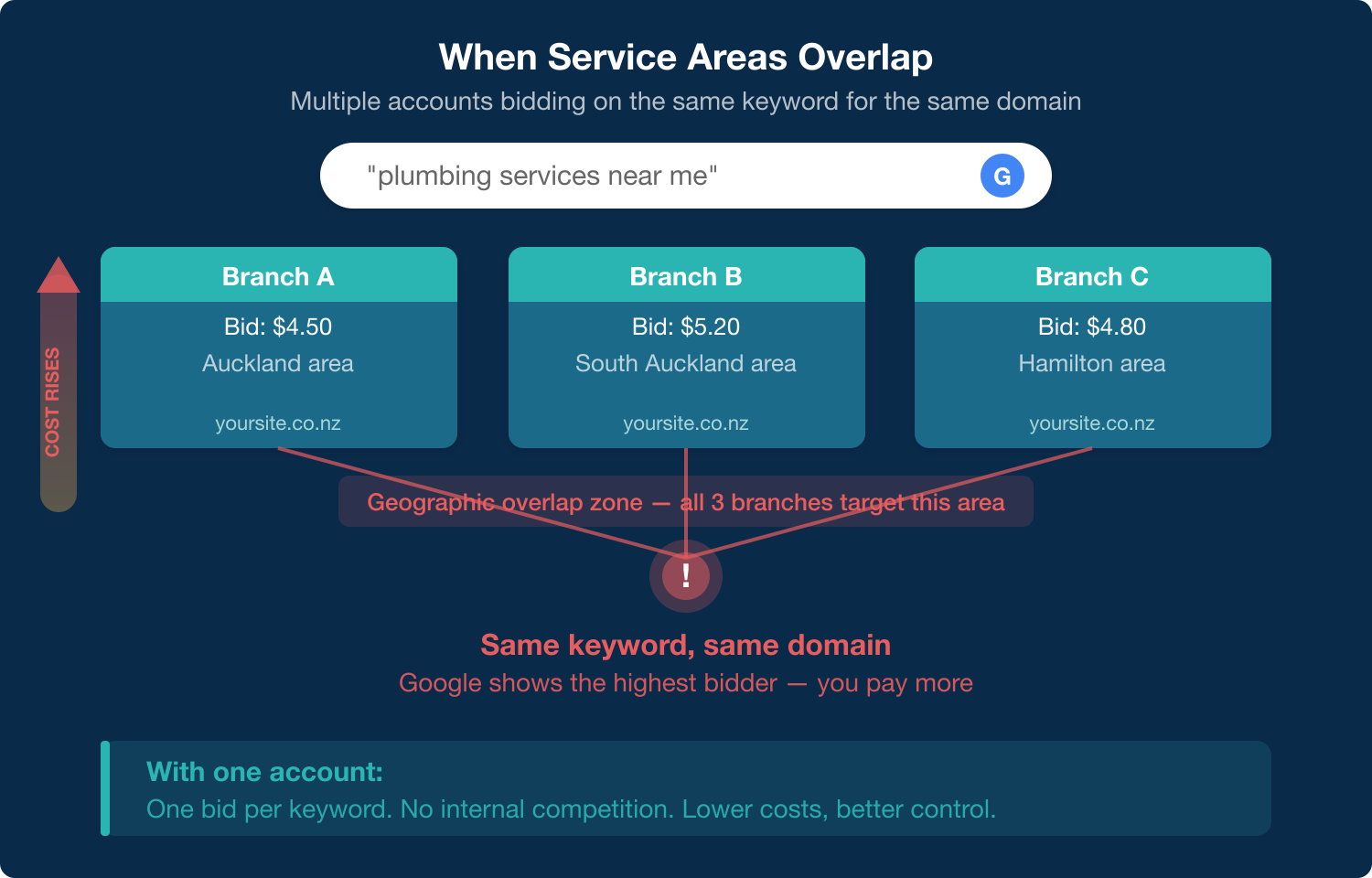
In a single account, there’s one bid per keyword. You control exactly which campaign serves which area, with no overlap and no internal competition. The cost comes down, and you can direct traffic to the most relevant landing page for each location.
Your data works harder
Google Ads rewards accounts that have enough data to learn from. Every click, conversion, and search term teaches the system what works. Split that data across five or six separate accounts and each one is learning slowly, in isolation.
A consolidated account pools all of that learning into one place. Negative keywords surface faster because you’re seeing more search terms. Smart bidding strategies have more data to work with. Quality Scores — Google’s measure of how relevant your ads are — tend to improve because the account has a stronger track record.
Think of it as the difference between five people each reading one chapter of a book, versus one person reading the whole thing. Only one of them actually understands the story.
You get proper geographic control
One of the concerns people raise is: “But we need each branch to show ads in their own area.” That’s a fair point — and it’s easily solved within a single account.
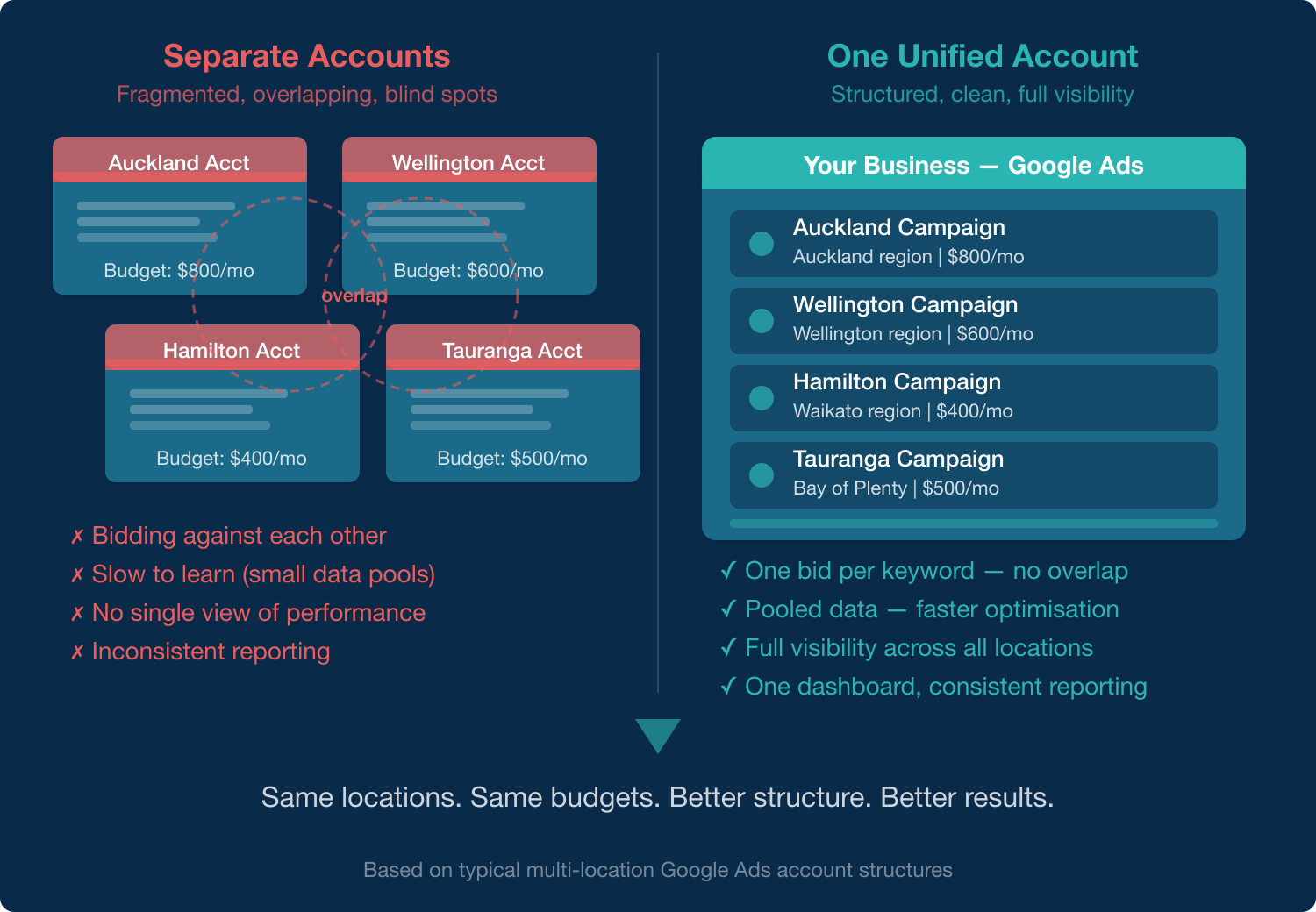
Google Ads has built-in location targeting. You can run separate campaigns for each region, each with its own budget, ads, and landing pages. The difference is that it all lives under one roof, so you can see the full picture and make decisions based on the whole business rather than one branch’s view.
You actually know what’s going on
When each branch runs its own account, reporting becomes a nightmare. Metrics get measured differently, budgets are tracked in different places, and nobody has the full picture. The head office asks “how are our Google Ads performing?” and the answer is a shrug followed by a spreadsheet cobbled together from six different sources.
A single account gives you one dashboard with consistent data across every location. You can compare regions, shift budget to where it’s working, and spot problems before they become expensive.
The transition is easier than you think
Most businesses expect the consolidation to be a major project. In reality, the hard part isn’t technical — it’s getting agreement from the branch managers who’ve been running their own show. The actual migration is straightforward: rebuild the campaigns in a single account with proper location targeting, pause the old accounts, and let the data start compounding.
This is something we handle regularly as part of our Google Ads management work. If you’re running multiple accounts and suspect they’re working against each other, complete the form below — it’s one of the more straightforward problems to diagnose and fix.