The AI model business is the most brutally competitive market going, and the companies in it have settled on a method for winning. Spend enormous sums making yourself permanently better, hold that improvement somewhere it cannot walk out the door, and run a fixed test to prove it worked. None of that requires a data centre. All of it works on an ordinary business, and I think over the next few years it will separate the businesses that survive the disruption from the ones that get flattened by it.
The bill nobody would sign off
Anthropic’s compute costs are reported to run at somewhere around $4 billion a year. The split is the part worth looking at. Roughly $2.5 billion goes on training, and roughly $1.5 billion on inference.
Inference is the bit that earns. It is what happens when you type something in and the thing answers. Every paying customer, every API call, every product they sell, all of it sits inside that $1.5 billion.
Training is the other thing entirely. It is building the next version. No customer served, no invoice raised, nothing shipped. Pure investment in being better later.
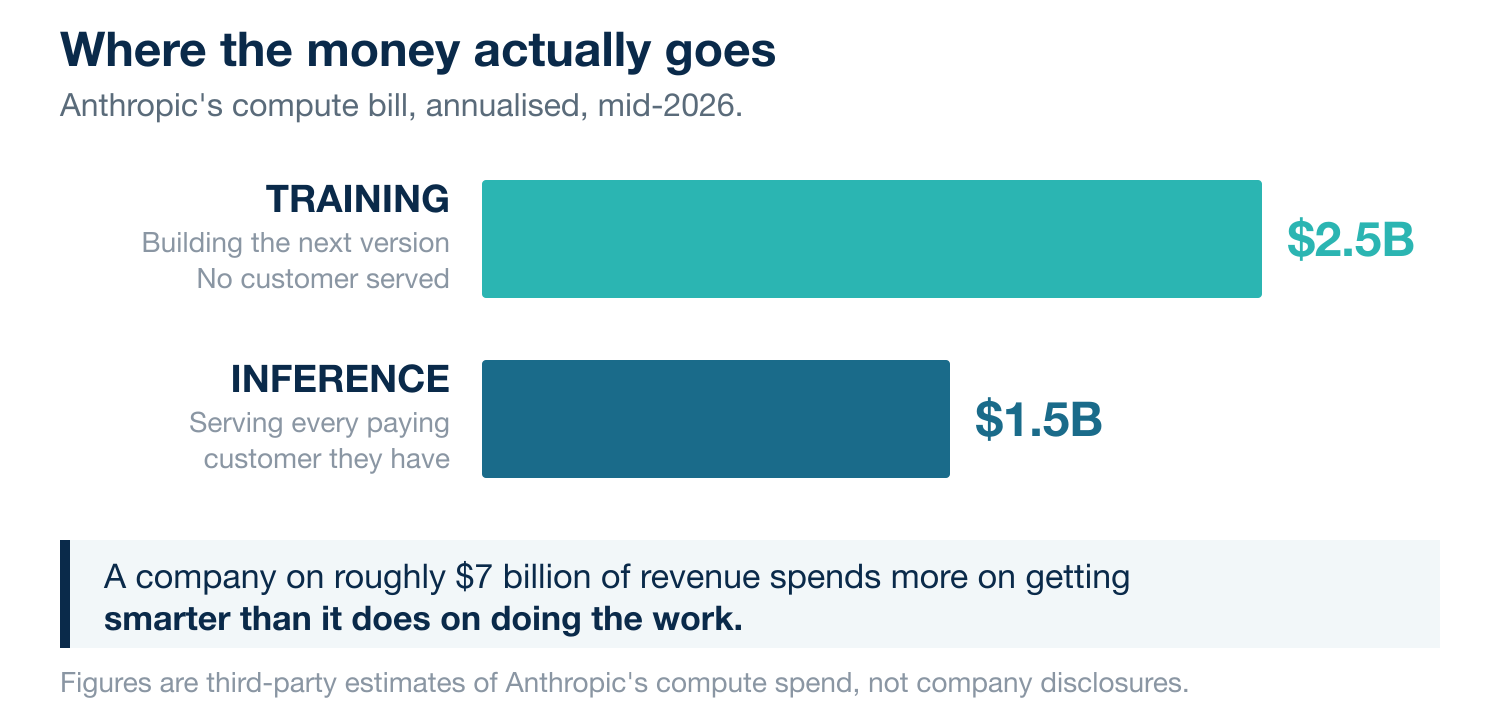
So a company doing around $7 billion in revenue spends more on getting smarter than on doing the work. Put that in your own accounts. More than half your operating spend, on capability, for a return you will not see until next year. I would struggle to get that past my accountant.
I might be off on the exact figures, these are outside estimates rather than anything Anthropic publishes. The direction is not in dispute, and the same pattern runs across the industry.
Why this particular industry is worth copying
Every business has some advantage it cannot hand over. Location, relationships, a licence, thirty years of reputation. The AI model companies have almost none of that. They buy the same chips, hire from the same small pool, publish their research, and their customers can switch providers in an afternoon by changing one line of code.
That is about as exposed as a market gets. And under that pressure they have converged on a way of operating that is completely visible from the outside. You can read what they spend, on what, and how they check it worked.
We are heading into a stretch where a lot of ordinary businesses are going to feel a version of that same pressure. So a method that was forged in the most contested market around, by people with no natural protection, is worth a look. Not because we are going to spend billions. Because the shape of it transfers.
Two kinds of intelligence, and only one of them stays
AI systems hold what they know in two completely separate places, and the distinction maps onto a business almost exactly.
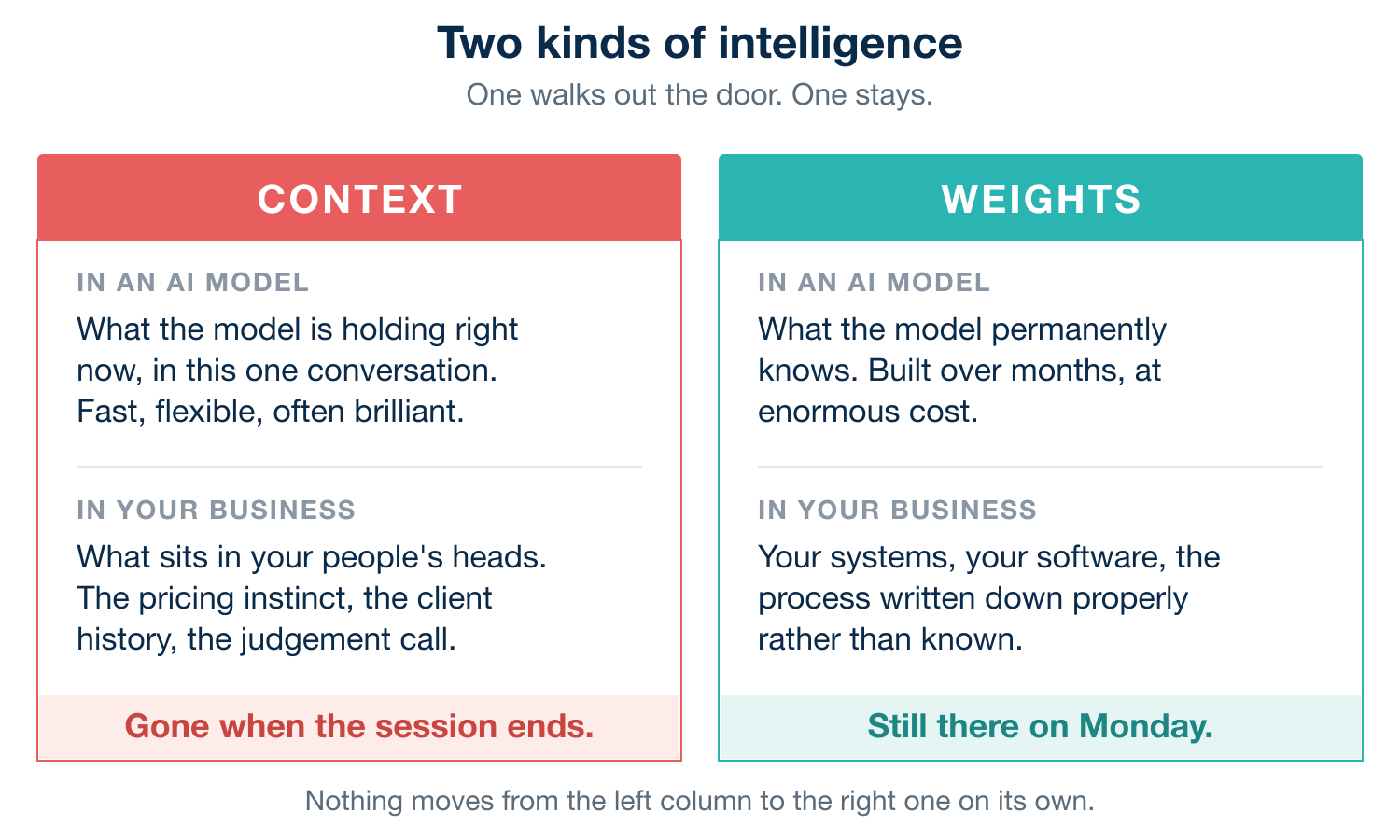
There are the weights. That is the model itself, what it permanently knows, built over months at enormous cost. Slow to change, expensive to create, and it survives everything. Switch it off and back on and the weights are unchanged.
Then there is the context window. That is what the model is holding right now, in this conversation. Fast, flexible, and often where the genuinely impressive work happens, because the model is reasoning about your specific situation rather than reciting something general. When the session ends, it is gone.
Your business runs on both.
The context is what sits in your people’s heads. The senior tech who knows which customers to ring before they complain. The estimator who looks at a job and prices it in ninety seconds. The account manager who remembers why that client went quiet in 2023. That is often the sharpest thinking in the building, and it is held in a session that closes the day they resign.
The weights are whatever is built into the business. The software you had made. The process that is written down properly rather than known. The checklist that catches the thing that used to get missed. The tool that does in a click what used to take an afternoon. That intelligence sits in the business rather than in a person, and it is still there on Monday no matter who left on Friday.
The bit almost everyone gets wrong
Most people assume that when they use ChatGPT or Claude, the model is learning from them. That the good conversation they had on Tuesday made it a bit better by Thursday.
It does not work like that. The weights were finished and frozen before you ever opened the thing. Your conversation lives in the context window for the length of that session and then it is gone. The model does not get smarter from talking to you. It never has.
The only way anything from those conversations reaches the model is if a human being deliberately collects it, curates it, and puts it through a training run to build the next version. That is a separate decision, months of work, and a very large bill. Nothing happens by default.
I would put an “at the moment” on that. Models that learn continuously are something people are working on and it may not stay true. Today it is.
Now hold that next to your own business, because the same wrong assumption is doing quiet damage in most of them. We tell ourselves that experience accumulates. Ten years of jobs, ten years of hard-won lessons, and surely the business is smarter for it. Some of it, sure. But most of what your team learned this year is sitting in a context window, and nothing reaches the business itself unless somebody deliberately collects it, works out what it means, and builds it into how the place runs.
Nothing happens by default there either.
We send people on courses, and I am not knocking that, we do it too. A course is a session. It runs, the person gets better, and the business gets better for exactly as long as that person stays. It went into context, not weights.
The failure is not hiring smart people. It is never turning what they know into something the business owns.
What writing to the weights actually looks like
None of this needs a software team.
A plumbing business where the quoting logic that lives in the owner’s head becomes a tool anyone on the team can run. A law firm where the three-page mental checklist that the good partner does automatically gets written down, and every file goes through it. In our case, analysis that used to depend on who was doing it, turned into something that runs the same way every time.
Unglamorous, all of it. And all of it is the business getting permanently better in a way that does not resign.
The economics of this have shifted, which is the part I would want an owner to notice. Building the tool, the automation, the system that encodes how you do something, that used to mean a developer, a budget and six months. It is now faster and cheaper by an order of magnitude. The reason to write things into your business has not changed at all. The price of doing it has fallen through the floor.
I wrote a while back that AI is handing every business a productivity dividend, and that the real decision is whether you bank it or spend it. This is my answer to the second half of that. If you are going to spend it, spend it on the weights.
How would you know it worked?
This is the part that started me thinking about all of it.
When a lab finishes training a model, they do not simply announce that it is better. They run evals. A fixed set of tests, identical every time, run against the old version and the new one. Coding problems, reasoning puzzles, questions with known answers. Same test, same conditions, and the score moves or it does not. The whole industry is organised around that scoreboard.
Ask how you would prove your business is better than it was a year ago. Most of us reach for revenue, and revenue is a poor eval, because it moves for reasons that have nothing to do with how good you are. A decent market covers for an awful lot.
A business eval would be a fixed set of scenarios you push through the place on purpose, and score.
Send an enquiry through your own website as a stranger, and time how long until a human replies. Judge whether the reply was any good. Run it every quarter.
Hand five jobs you have already quoted to a different person to quote from scratch, and look at how far apart the numbers land.
Ring your own business at 4:50pm on a Friday. Yes, really.
Walk a complaint you handled badly two years ago through the business as it stands now, and see whether it goes better this time.
Time one job type end to end today, then do it again in six months.
The discipline is in running the same test, unchanged, so the comparison means something. Change the test each time and you have got an opinion. Keep it fixed and you have got a measurement.
Where we have got to with it
We are partway through this rather than finished, so take it as a work in progress.
Most of what we have built over the last two years has been an attempt to write things into the weights. The thinking that used to depend on who was on the account, turned into something the business does the same way every time. It is why a client gets the same standard of analysis on their Google Ads campaigns regardless of who is looking after them, which was never quite true when it all lived in people’s heads.
We do not have a full eval suite. We have got pieces of one, and the rest is on the list.
The honest version
I would not push the analogy past where it goes. A business is not a model. Most of what makes a good one is relationships and judgement and turning up, and none of that reduces to a score. There is a version of this thinking that ends in measuring everything and understanding nothing.
But three questions get answered in that industry every quarter, in dollars, and they are worth borrowing.
How much of what we spend goes on getting better, rather than on doing the work? For most businesses that rounds to nothing.
Where does it land, in the business or in a person? Almost always a person.
And what would tell us whether it worked? Usually there is no answer, because nobody set a test.
The advantage in front of us is not that AI will do our work for us. It is that the cost of building intelligence into a business has collapsed, at exactly the moment when having done it starts to matter. Your competitor can buy the same AI tools you can, next week, off the same shelf. What they cannot buy is a business that has spent two years writing what it knows into itself.
If you want a hand working out what is sitting in your people’s heads that ought to be sitting in your business, that is a conversation we enjoy having. The form below comes straight to me.