Website Migration SEO

The Problem: Website Migrations Are High-Stakes
Years of SEO equity can disappear overnight with a poorly managed migration. The pages that rank well, the links you’ve earned, the authority you’ve built – all of it is at risk when URLs change.
The common issues:
- SEO isn’t always in scope – Many developers have solid SEO knowledge but don’t want to manage this aspect of the project. There’s enough to coordinate already without adding redirect maps for 5,000 pages to the list.
- The risks aren’t always visible – Clients may underestimate the SEO impact, not be fully aware of the risks, or simply assume everything will transfer automatically. When rankings drop and the phone stops ringing, recovery can take months.
- The “big dip” is common – but not inevitable. With proper planning, you can maintain visibility through the transition.
The scale can be significant:
One recent migration project involved 11,877 URLs with over 5,000 pages requiring individual redirect mapping. E-commerce sites can lose $30,000 or more per month in revenue when rankings drop unexpectedly.
How We Work Alongside Your Build
We integrate with your project timeline, not the other way around. Our four-phase approach runs parallel to your development work.

Phase 1: Pre-Migration Audit
Before any development begins, we analyse what’s currently working:
- Identify your highest-traffic pages and their revenue contribution
- Document which keywords drive business results
- Map existing URL structures and internal linking
- Establish baseline metrics for measuring success
Phase 2: New Site Review
As your new site takes shape, we review the technical SEO foundations:
- URL structure and hierarchy
- Navigation and internal linking architecture
- Page templates and on-page elements
- Technical SEO readiness (speed, mobile, crawlability)
Phase 3: Migration Planning
The detail work that protects your rankings:
- Create comprehensive redirect maps (1:1 where possible)
- Prioritise high-traffic and high-converting pages
- Plan for content that’s changing, merging, or being removed
- Coordinate timing with your development team
Phase 4: Launch Support & Ongoing Reporting
Active monitoring during the critical go-live period and beyond:
- Verify redirects are working correctly
- Submit updated sitemaps to search engines
- Monitor for crawl errors and broken links
- Catch issues early before they compound
Weekly post-launch reporting tracks your recovery:
- Estimated traffic trends compared to pre-migration baseline
- Keyword ranking movements across your target terms
- Reports continue weekly until traffic has stabilised
We Handle Different Migration Types
Every migration is different. Here’s how we approach the common scenarios.
Platform Migration
Moving from legacy systems to modern platforms requires careful planning, especially when dealing with established sites.
What’s involved:
- Mapping old URL structures to new platform conventions
- Handling product catalogs, category pages, and filtered URLs
- Preserving metadata and structured data
- Managing pagination and parameter-based URLs
Example: A 20+ year old e-commerce site with over 5,000 product pages migrating to a modern platform. Every URL needed mapping, with priority given to the pages driving actual revenue.
Content Consolidation
Sometimes the best migration strategy involves reducing what you migrate.
What’s involved:
- Semantic analysis to identify which content actually delivers value
- Finding duplicate and near-duplicate pages that dilute authority
- Consolidating thin content into comprehensive resources
- Reducing migration workload without losing what matters
Example: A site with 400+ blog posts analysed using semantic similarity. We identified which posts were genuinely unique versus near-duplicates, allowing the team to migrate only content that delivered value – resulting in a cleaner, more focused site.
Domain Merger
Bringing two businesses together under one domain involves more than just redirects.
What’s involved:
- Managing content overlap without cannibalisation
- Combining link equity from both domains
- Handling Google Business Profile consolidation
- Maintaining local search visibility during transition
Example: Two established insulation businesses with 35,000+ combined customers merged under a single brand. The migration preserved search visibility across both customer bases while building authority for the unified brand.
What Success Looks Like
Here’s what proper migration planning delivers.
Case Study: NZ E-commerce Retailer
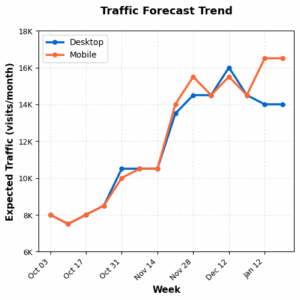
This chart tracks estimated monthly traffic based on keyword rankings. The website migrated around October 10th – you can see the brief dip as Google re-indexed the new site, followed by steady recovery and growth.
The situation: A 25-year-old e-commerce site with significant annual revenue at risk. The platform was outdated, but years of SEO investment had built strong organic visibility.
The approach: Comprehensive redirect mapping for thousands of product pages, with priority given to revenue-generating URLs. Close coordination with the development team throughout the build.
Why it worked so well: The web developer delivered an exceptionally fast website. Site speed is a ranking factor, and the performance improvements gave Google additional reasons to favour the new site – accelerating the recovery.
The result:
- +74.8% traffic growth post-migration
- 673 keywords tracked with 60% recovery rate
- Revenue maintained through the transition period
Case Study: Auckland Service Business

This chart tracks estimated monthly traffic based on keyword rankings. The two domains merged in April – rather than the typical post-migration dip, traffic grew steadily as the combined site built authority.
The situation: Two established businesses merging under one brand, with overlapping service areas and content.
The result:
“I don’t think we’ve ended up with the big dip. We still got plenty of work coming in, plenty of leads coming in, plenty of product sales coming in. Your brief on what to expect was great and that’s a real success for you because that sort of upfront preparation was really valuable.”
— Business Owner
Case Study: Professional Services Firm
The situation: A content-heavy site with 400+ blog posts accumulated over many years. Much of the content was outdated, duplicative, or underperforming.
The approach: Semantic content analysis to identify truly unique versus near-duplicate content. This allowed the team to focus migration efforts on pages that actually delivered value.
The result: A cleaner, more focused site with preserved rankings for content that mattered – and significantly reduced migration workload.
Why Work With Us
For Developers
We complement your work, not compete with it. You maintain the client relationship. We provide the SEO expertise you need without the overhead of hiring specialists.
- We integrate with your project timeline and tools
- Clear documentation you can share with clients
- Available for client calls when you need SEO questions answered
For Business Owners
Clear communication throughout. Weekly updates, documented decisions, and no surprises.
- Flexible billing – monthly as work progresses, not large upfront costs
- Realistic expectations set from day one
- Direct access to the team working on your project
For Everyone
Experience that matters:
- Operating since 2003 with multiple successful migrations
- Data-driven approach including semantic content analysis – not guesswor
- We’ll tell you honestly if you need us – some migrations don’t require specialist SEO support
Investment
Investment depends on the complexity of your migration:
- Number of pages requiring redirect mapping
- Type of migration (platform change, domain merger, content consolidation)
- Timeline and level of ongoing support needed
We scope each project individually after understanding your situation. Billing is monthly as work progresses – no large upfront costs.
Let’s Discuss Your Project
Free initial consultation to understand your migration timeline and requirements.
We’ll tell you honestly if you need us. Some migrations don’t require specialist SEO support – if yours is one of them, we’ll say so.
Fill in the form below or give us a call on 0800 437 628.