Brand Messaging & Differentiation

Most marketing problems aren’t traffic problems. They’re message problems.
The ads work, the SEO ranks, the social campaign drives clicks, and the visitor lands on a page that sounds like every other page in the category and leaves without doing anything. That’s not a budget issue. That’s a sameness issue.
We’ve spent more than two decades watching businesses spend their way around weak messaging. Some of them get away with it for a while. Most don’t.
If you’ve never had an outside read on your messaging, our free 60-minute Marketing Message Audit is the place to start. You walk away with a written summary of what’s working, what isn’t, and what to do about it.
The Sameness Problem
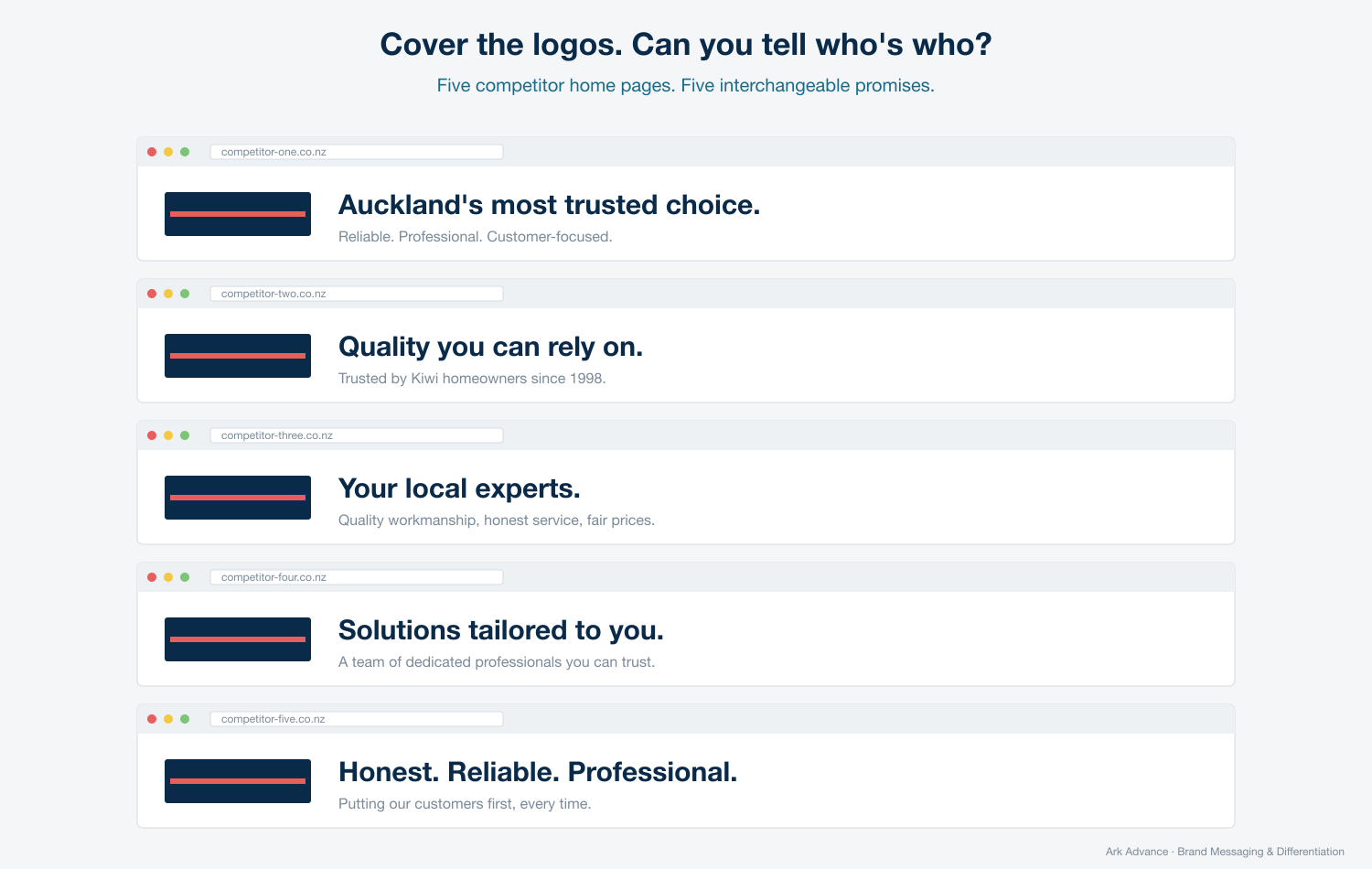
Open five competitor websites in your industry. Read the homepage hero text on each. Cover the logos.
If you can’t tell which company is which, that’s the problem we’re trying to solve. It’s the most common pattern we see when we audit a new client’s marketing: generic claims (“trusted, reliable, professional”), undifferentiated promises, and a list of services that reads identically to the next site down the search results page. Google doesn’t care. The visitor cares, for about three seconds, before they hit the back button.
A strong message doesn’t have to be clever. It just has to be specific enough that the right customer recognises themselves in it, and different enough that they remember you afterwards.
What We Actually Do
Brand messaging sounds like it could mean anything, so let’s be specific. Here’s what working with us on this looks like.
Marketing Message Audit (free, 60 minutes)
The starting point for most clients. We review your current website, ads, and key sales collateral together in a recorded session, then send you a written summary of what’s working, what isn’t, and what to fix. Full details on the Marketing Message Audit page →
Differentiation Workshop
For businesses that know their message isn’t quite right but can’t put their finger on what to change. We work through what your customers actually buy you for (often different from what you think), where you sit in the competitive set, and what you can credibly own that nobody else can. The output is a short positioning brief you can use across your website, ads, and sales conversations.
Message-to-Market Refresh
For businesses where the message has drifted out of sync with the product. Maybe you’ve grown into a different segment, added services, raised prices, or changed who your best customer is, but the website still talks to the customer you had three years ago. We rebuild the core messaging so what you say matches what you now sell.
Implementation Across Channels
Once the message is right, it has to land everywhere. We rewrite the homepage, the key service pages, the ads, and the email follow-ups so the same idea shows up in the same words across every customer touchpoint. Most agencies stop at the website. We carry it through, because the moment a Google ad headline contradicts the homepage, conversion rate drops.
Why This Matters Now
For most of the last twenty years, weak messaging was a slow-bleed problem. You could get away with it as long as you outspent the competition or your category wasn’t crowded. That’s getting harder for two reasons.
Google Ads keeps getting more expensive. When a click costs $5 and the conversion rate is 2%, you’re paying $250 to find a customer. The message on the landing page is the difference between that customer converting and disappearing. Weak messaging shows up directly in the cost-per-acquisition column.
AI search recommends specific businesses, not categories. When someone asks ChatGPT or Google’s AI Overview “who’s the best plumber in Auckland”, the model picks one or two names. The pick isn’t going to the company with the best SEO; it goes to the one with the most distinctive, well-articulated reason to be picked, drawn from reviews, third-party mentions, and the business’s own content. Generic positioning is invisible to AI in a way it never was to traditional search.
We wrote about this in detail in Why AI Makes Your Marketing Message Matter More, worth reading if you’re trying to work out what AI changes for you.
Some Examples Of Message Work In Practice
AMP Annealing. A precision-engineering business where the product was so far ahead of the category that the messaging hadn’t caught up. Reframing the product around what it actually solved (consistency, repeatability, time-saving for serious reloaders) instead of feature-listing let the marketing finally do the product justice.
IKEA’s wordless campaign. A reminder that strong messaging isn’t always about words. Sometimes it’s a single image that tells the customer “we get you” before they read a thing.
Landing page rewrite, 118% lift. A working example of what changing the message (not the traffic, not the offer) does to conversion rate when the original page was generic.
How This Fits With The Rest Of Your Marketing
Messaging is the layer that sits underneath every other marketing channel. Get it right and the ads carry their weight, the search rankings start matching what people actually buy, and brand searches start showing up in the Google Ads account that didn’t used to be there.
Get it wrong and everything downstream is a rounding error.
That’s why we usually start here when we take on a new client, and why this work feeds into the Google Ads, SEO, and social media advertising we run for the same clients afterwards. The message is the constant. The channels carry it.
If you’d like an honest read on whether your current message is strong enough, or you already suspect it isn’t, book a free Marketing Message Audit or complete the form below and we’ll be in touch.
Further Reading
We write regularly about messaging and differentiation on our blog:
- Stand Out and Grow — The Path to Affordable Business Growth
- What IKEA Taught Me About Messaging (Without Saying a Word)
- Show, Don’t Just Tell: The Visual Advantage
- When Your Message Drives Your Product: AMP Annealing
- When Your Message Sounds Like Everyone Else’s
- Why AI Makes Your Marketing Message Matter More